
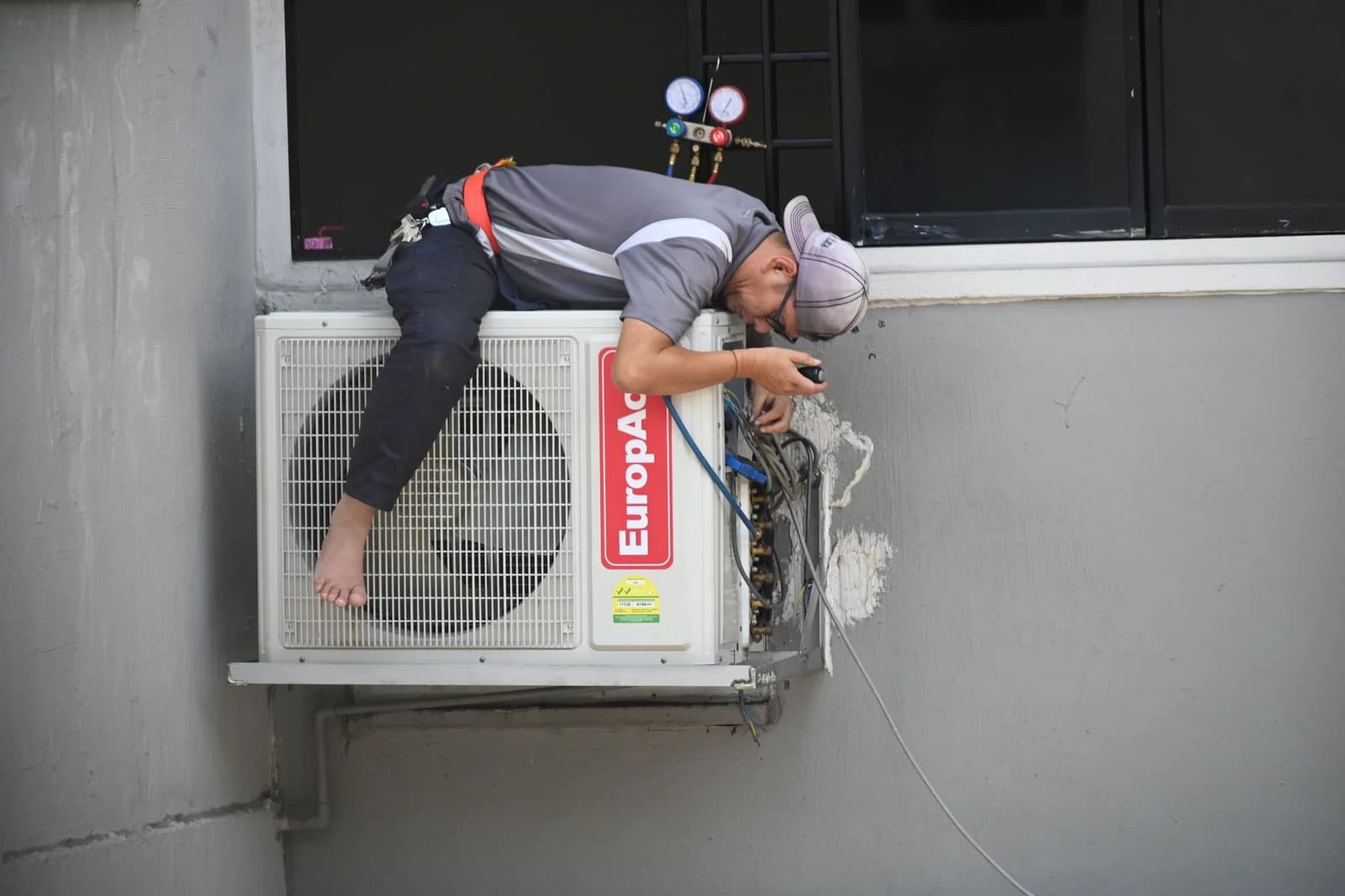
A Confusing Symptom: Ice From a Machine Meant to Cool You Down
Few AC symptoms confuse homeowners as consistently as ice. It seems backward: a system that's supposed to be removing heat somehow builds frost on its own components, and the instinct is to assume more cooling is happening, not less. In reality, ice on the refrigerant lines or the indoor coil is one of the clearest signs that something in the system has gone wrong, and running the system while it's frozen almost always makes the underlying problem worse rather than better.
Why Ice Forms on a Cooling System at All
Your evaporator coil runs cold by design, cold enough to pull both heat and humidity out of the air passing over it. Under normal conditions, that coil stays just above freezing, cold enough to do its job without actually forming ice. When something disrupts that balance, either by restricting the airflow moving across the coil or by lowering the refrigerant pressure inside it, the coil's surface temperature can drop below freezing, and the humidity in the air passing over it turns to frost instead of condensing normally. Once a small amount of ice forms, it restricts airflow even further, which drops the temperature even more, and the ice builds on itself in a cycle that gets worse the longer the system keeps running.
Cause One: Restricted Airflow
This is the most common cause we find, and it has several possible sources. A badly clogged filter is the simplest and most frequent, but closed supply vents in unused rooms, a partially collapsed section of flexible duct, or a return vent blocked by furniture can all reduce airflow enough to trigger freezing. A failing blower motor that's no longer moving air at full capacity produces the same effect even with a clean filter and open vents. In every one of these cases, the coil itself and the refrigerant charge are perfectly healthy; the problem is simply that not enough air is passing across the coil to keep it above freezing.
Cause Two: Low Refrigerant Charge
A system that's lost refrigerant through a slow leak runs at lower pressure than it should, and lower pressure allows the coil to get colder than normal even with airflow that would otherwise be adequate. This is a different root cause from the airflow problems above, but it produces the exact same visible symptom, ice on the coil or the lines, which is exactly why a proper diagnosis has to check both airflow and refrigerant pressure rather than assuming one or the other from the symptom alone.
Cause Three: A Failing Blower Motor
Even with a clean filter and clear vents, a blower motor that's lost some of its output, often from worn bearings or a failing capacitor of its own, can move less air across the coil than the system was designed for. This is a less common cause than a clogged filter, but it's worth checking when a homeowner tells us the filter was just replaced and the vents are all open, and ice is still forming.
What Ice Actually Does to Your System if You Keep Running It
Running a system that's already iced over doesn't just fail to cool your home, it actively risks damaging the compressor. As ice builds up and airflow drops further, liquid refrigerant can make its way back to the compressor instead of fully evaporating in the coil first, a condition that can flood the compressor with liquid it isn't designed to handle. Compressors are built to compress gas, not liquid, and this kind of flooding is one of the more expensive failures we see, entirely avoidable simply by shutting the system off as soon as ice is noticed rather than continuing to run it.
What to Do the Moment You See Ice
Turn the system off at the thermostat, and switch the fan to run on its own if your thermostat allows it. Running just the fan, without the compressor engaged, helps the coil thaw faster than leaving everything off completely. Depending on how much ice has built up, full thawing can take anywhere from a couple of hours to closer to a full day for a heavily iced system. Do not attempt to speed this up by chipping at the ice directly, since the coil fins underneath are thin and easily damaged. Once the system is fully thawed, and only then, it's worth having a technician look at it, since restarting an iced system without addressing the underlying cause just restarts the same freezing cycle.
Ice on the Lines Versus Ice on the Indoor Coil
Ice visible on the copper refrigerant lines running to your outdoor unit is usually easier to spot, since it's out in the open. Ice on the indoor evaporator coil itself is often hidden behind an access panel and may not be visible at all until water starts pooling near the air handler as the ice melts between cycles. If you notice unexplained water near your air handler along with weak airflow, indoor coil icing is worth suspecting even if you can't see the ice directly.
Why This Shows Up More Often in Certain Santa Clarita Valley Homes
Homes in Canyon Country and Saugus with attic mounted air handlers and longer duct runs tend to see filter related icing more often, simply because dust and Santa Ana wind debris settle into return air over the summer faster than homeowners expect, and a filter that looks fine at a glance can already be restricting airflow enough to matter. Checking the filter every sixty to ninety days during the cooling season, rather than waiting for a visible sign of trouble, catches this cause before it ever produces ice in the first place.
What a Proper Diagnosis Looks Like Once the System Has Thawed
We check airflow at the filter, the vents, and the return, confirm the blower motor is moving air at its rated capacity, and measure refrigerant pressure to rule out or confirm a low charge. Because airflow problems and refrigerant problems produce the same visible ice, we don't stop at the first plausible explanation, we confirm which one, or whether it's both, before recommending a repair.
Keeping Ice From Coming Back
Once a system is repaired, whether the cause was airflow, refrigerant, or a failing blower motor, there are a few habits that make a repeat freeze far less likely. Check the filter on a regular schedule rather than waiting until it looks visibly dirty, since airflow can drop enough to matter before a filter looks obviously clogged. Keep supply vents open throughout the house, even in rooms you don't use often, since closing too many vents at once reduces total airflow across the system more than most homeowners expect. And if the system ever starts to feel weaker than usual, even without visible ice yet, treat that as an early signal worth a call rather than waiting for frost to confirm it.
Why Icing Deserves a Same-Day Look
Unlike some AC symptoms that are safe to monitor for a few days before calling, icing is one we treat as worth same-day attention. That's not because the ice itself is dangerous, it's because continuing to run an iced system risks the compressor, and a compressor failure is a far more expensive and disruptive repair than whatever originally caused the ice. Catching the underlying airflow or refrigerant issue before it reaches the compressor is almost always the more affordable outcome, and it's the reason we prioritize icing complaints the same way we would a complete no-cool call.
Get an Iced System Properly Diagnosed
If you've noticed ice on your AC's lines or coil, shut the system off and call Newhall AC & Heating at (877) 583-4462. We'll confirm the system has fully thawed, find the actual cause, and get it running correctly again rather than just restarting the same freezing cycle. We serve Newhall, Canyon Country, Saugus, Valencia, and Stevenson Ranch.
Need Professional HVAC Service?
Our HVAC-experienced technicians are ready to help with all your AC and heating needs. Contact Newhall AC & Heating today for expert service throughout the the Santa Clarita Valley service area.